Introducing Geovation Scotland’s newest Enterprise-in-Residence – Urban Airspaces
Who should have a say in the future of our skies?
As drone technology continues to advance, the opportunities are clear: faster deliveries, smarter infrastructure monitoring and enhanced emergency response. Yet while innovation is accelerating, mechanisms for representing local communities in airspace decision-making have struggled to keep pace.
Enter Urban Airspaces, Geovation Scotland’s newest Enterprise in Residence. The team is building a platform that helps local authorities define and manage policies for low-altitude airspace, ensuring community priorities can be considered alongside technological progress.
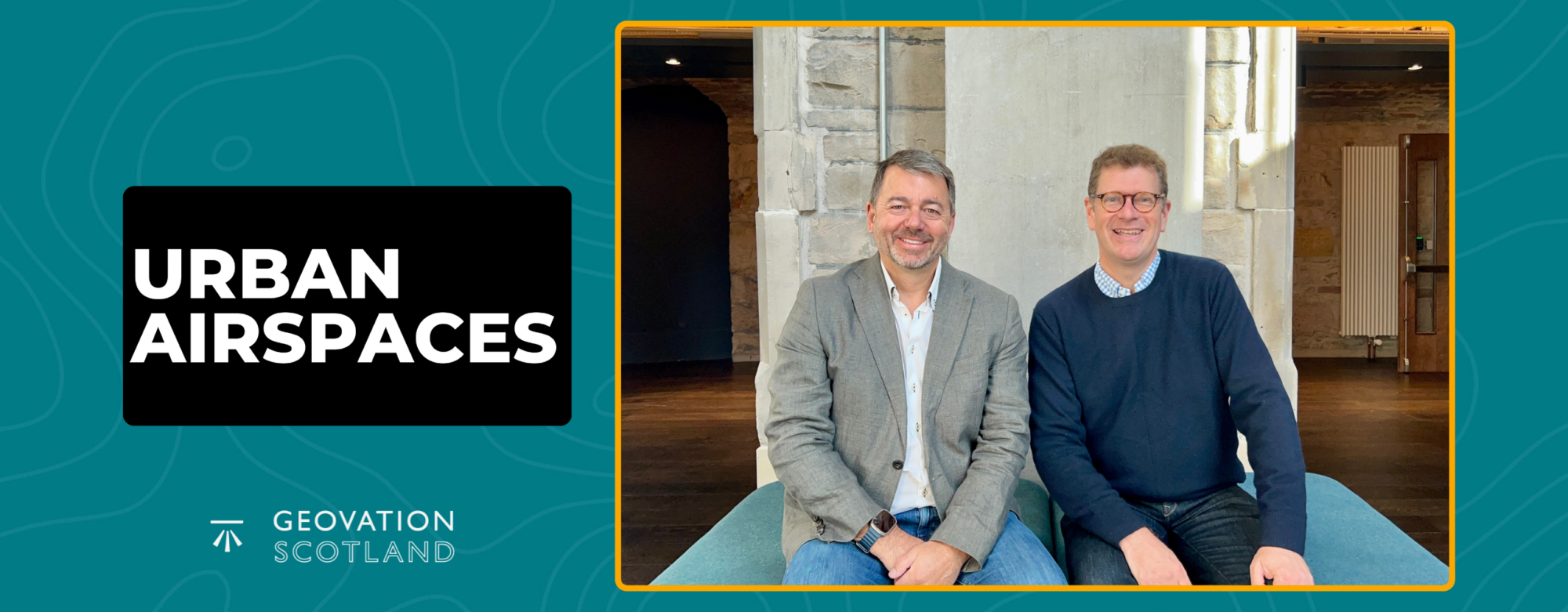
We spoke with founders Mark McLauchlan and Robert Walker about their vision for the future of urban airspace, the challenge they’re tackling, and the connections they’re looking to make through the Geovation network.
Tell us about your start-up – what problem are you solving and why does it matter?
Drones are transforming how we use the skies above our towns and cities, from deliveries and infrastructure inspections to emergency services. However, while aviation technology is advancing rapidly, there is no effective way for local authorities to influence how low-altitude airspace is managed above their communities.
Urban Airspaces is developing a geospatial governance platform that enables local authorities to define and publish local airspace policies as machine-readable spatial rules. This ensures that important local considerations, such as schools, hospitals, public spaces and major events, are reflected in drone operations.
Our mission is to give communities a meaningful voice in how their skies are used, helping balance innovation with local accountability, public trust and good governance.
Tell us more about the team at Urban Airspaces and your background.
Urban Airspaces was co-founded by Mark McLauchlan and Robert Walker.
Mark leads technology and product development, bringing over 25 years’ experience in software engineering, technology architecture and GIS. He holds an MSc in Geographic Information Systems from the University of Edinburgh and is a Chartered Geographer, Fellow of the Royal Geographical Society and Honorary Fellow of the University’s School of GeoSciences.
Robert leads commercial strategy and business development, drawing on experience across banking, enterprise technology, start-ups and private equity. He is also undertaking a PhD at the University of Glasgow, researching digital twins and intelligent transport systems as part of the TransiT transport decarbonisation programme.
We are supported by a wider team with expertise in digital product design, alongside advisers from policing, emergency management and decision intelligence backgrounds.
What inspired you to start the company?
Urban Airspaces began with a shared interest in how autonomous systems would change cities, and a recognition that much of the investment in innovation was focused on the aircraft themselves and the systems needed to operate them, rather than the communities beneath them.
Combining backgrounds in geospatial technology, intelligent transport systems and enterprise software, we recognised an opportunity to connect local policies and spatial data with emerging digital aviation systems.
That initial idea has since developed into a working prototype and a clearer understanding of the practical challenges facing local authorities.
What do the next 6-12 months look like for the company?
Over the next 6–12 months, the aim is to validate the platform in real-world settings and establish a clear route to market.
We’ve already had encouraging discussions with local authorities, regional transport partnerships and organisations exploring drone operations, particularly in healthcare and logistics. The priority now is to turn those conversations into practical collaborations, working with partners to understand their requirements and demonstrate how local airspace policies can be managed digitally.
Alongside developing the platform, we’ll explore how authoritative geospatial data from Ordnance Survey and other sources can support more sophisticated spatial analysis, including identifying sensitive locations, infrastructure, and potential ground risks.
We’ll also be pursuing commercial partnerships in the UK and internationally, particularly in markets investing in smart cities and advanced air mobility.
What experience do you bring to the Geovation Scotland community? How can you support those in our network?
We bring experience in technology architecture, business development and technology due diligence for investors, including assessing businesses at different stages of growth.
One area where we can particularly help is understanding what investors look for when assessing a technology business. Decisions about architecture, security, documentation and how technology is managed can be difficult to revisit later. Our advice is to start with the end in mind: establish good practices early but keep them proportionate to the size and stage of the business.
We’re also happy to share our wider experience of developing technology businesses, including lessons from things that haven’t gone as planned. We’re also keen to learn from other founders in the Geovation community.
How can people in our community support you?
At this stage, the most valuable support is introductions and conversations. We’re looking to connect with local authorities, smart city programmes and public sector organisations exploring drones, advanced air mobility and the future management of urban airspace.
We’d also welcome discussions with drone operators, aviation technology providers and organisations in sectors such as emergency services, healthcare logistics and infrastructure inspection to better understand their operational challenges.
We’re interested in connecting with geospatial specialists, digital twin practitioners, potential commercial partners and investors with an interest in GovTech, geospatial technology and emerging transport systems.
Above all, we’d love to hear from anyone who can offer a different perspective, challenge our thinking or highlight opportunities we may not yet have considered.
Could your expertise, network or insight help shape the future of urban airspace? Get in touch with the team directly using the links below.
Website: https://www.urbanairspaces.com
Mark’s LinkedIn: https://www.linkedin.com/in/markmclauchlan/
Robert’s LinkedIn: https://www.linkedin.com/in/rowalker/
Email: contact@urbanairspaces.com